- In business, sales don’t just mean selling a product – it’s about creating a reason in the customer’s mind.
- We often assume that if the customer hears only about the benefits, they’ll buy immediately.
- But in reality, that doesn’t always happen. Sometimes, customers care more about features, while in other cases, they focus more on benefits.
👉 So the question is: when explaining to a customer, which one should you focus on?
First, understand the difference between Feature and Benefit
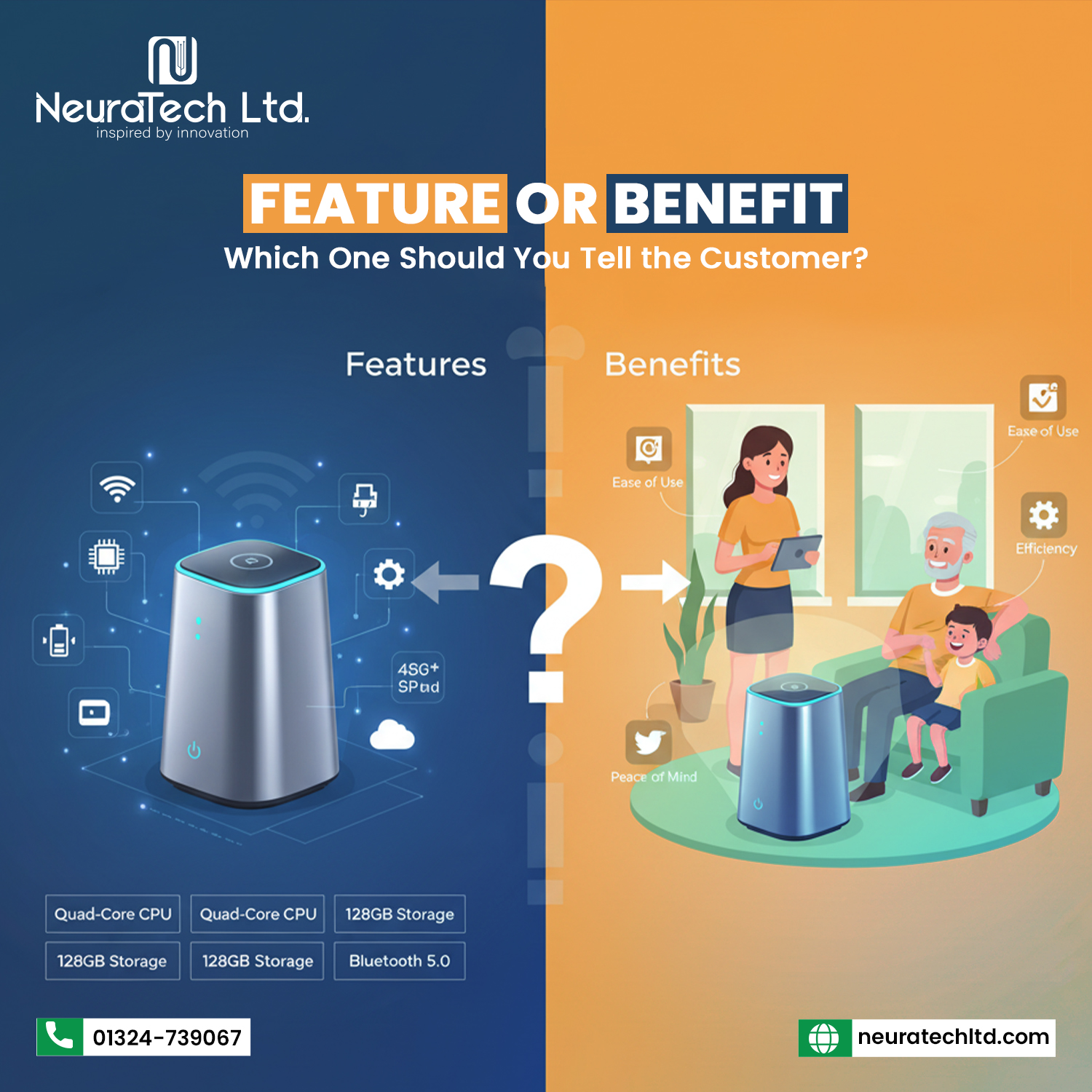
- Feature: The qualities or technical details of a product.
- Example – “This phone has a 5000mAh battery.”
- Benefit: The value the customer gets from that feature.
- Example – “This phone lasts two full days on a single charge.”
A product’s features create its benefits. But deciding which one to highlight depends on the product type and the customer’s psychology.
Example 1: Fast Food or Snacks
Suppose you run a burger shop.
If you say: “Our burgers will fill your stomach.” → That’s a benefit, but sounds ordinary.
If you say: “Every burger has 100% original beef patty and special homemade sauce.” → That’s a feature, but it builds a guarantee of taste in the customer’s mind.
👉 In this case, telling the story through features makes customers more attracted.
Example 2: Coffee Shop
Benefit: “Our coffee will refresh you.”
Feature: “Our coffee beans are sourced from single-origin farms in Brazil, where each cup offers more than 2000 flavor notes.”
👉 Here, the feature actually proves the benefit. The customer thinks: “Oh, that’s why it’s special.”
Example 3: Software or Services
Suppose you’re selling CRM software.
Benefit: “This software will make your sales team’s work easier.”
Feature: “Our software has an auto-reminder system that saves you from missing daily client follow-ups.”
👉 By telling the feature as a story, customers can clearly see where the benefit lies.
Example 4: Personal Care Product
Benefit: “Our hair oil reduces hair fall.”
Feature: “Our hair oil contains 100% cold-pressed hibiscus flower and aloe vera extract, which strengthen hair roots and show visible results in just two weeks.”
👉 Here, the feature strongly establishes the benefit.
So, which should you tell – Feature or Benefit?
The direct answer is: Both, but in the right way.
- Start with the benefit – because customers always want to know: “What’s in it for me?”
- Then explain the feature – to prove that the benefit is real and trustworthy.
Why is this important?
- If you say only the benefit, it sounds nice but lacks proof.
- If you say only the feature, it gives information but customers can’t connect with it.
- But if you combine features + benefits into a story, your message becomes more believable.
Conclusion
While selling, it’s not enough to just say, “This product will help you.”
You need to make the customer understand:
👉 Why the product is unique,
👉 What special features it has,
👉 And how those features will bring real benefits to their life.
Remember, a good product can’t be sold just with posters or ads.
A good product sells through the right storytelling.
When you sell your product, do you start with the benefit first, or the feature?